3-axis vs 5-axis: choose the machining route
Compare fixed-axis, indexed 3+2 and simultaneous 5-axis milling by access, orientation and total process needs.
013-axis
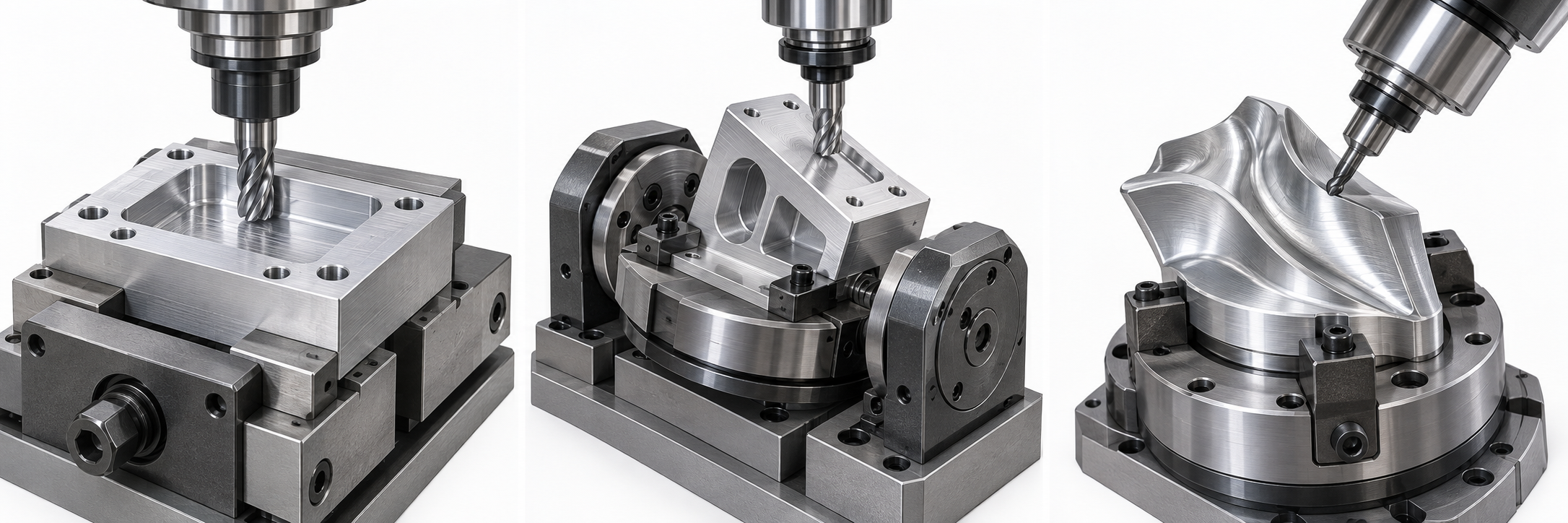
FIXED ORIENTATION
X, Y and Z motion; the tool axis stays fixed relative to the part during a setup.
Consider for: Accessible pockets, holes, plates and many 3D contours.
Other faces may need re-fixturing. A curved surface alone does not require 5-axis.
02Indexed 3+2
POSITION, THEN CUT
Two rotary axes orient the part or tool, then stay fixed during each 3-axis cutting operation.
Consider for: Angled holes, multiple faces and fixed-angle access.
Can reduce re-clamping. Verify the fixture, rotation envelope and every approach.
03Simultaneous 5-axis
ORIENT WHILE CUTTING
Linear and rotary axes coordinate; tool orientation can change along the cutting path.
Consider for: Selected sculpted surfaces, blade passages and changing tool-angle needs.
Requires suitable CAM, postprocessor, machine kinematics and collision verification.
Start with the feature, not the machine label
- 1Can the feature be reached from a fixed tool direction?YES: evaluate 3-axis for that feature.
NO: review another orientation or process.
- 2Do a few fixed angles provide the necessary access?YES: compare indexed 3+2 with separate setups.
Check grip, datums and tool/holder clearance.
- 3Must the tool angle change during the cut?YES: evaluate simultaneous 5-axis.
If access still fails, redesign or discuss another process.
Review every feature. One part can use several modes; the gripping face may still need a second operation.
Four checks that apply to every route
Tight tolerances
Axis count is not an accuracy rating. Review datums, machine capability and measurement.
Thin walls
Support, clamp force and cutting load still govern. Extra axes do not make a wall rigid.
Deep features
Tilting may shorten reach only if the holder, fixture and surrounding walls clear.
Cost & lead time
Compare setup, programming, cycle, inspection and quantity. No route is always cheapest.
Bring to the machining review
Revision-matched model & drawing / material & condition / quantity / critical interfaces & datums / finish / inspection & delivery needs